
Your shopping cart is empty
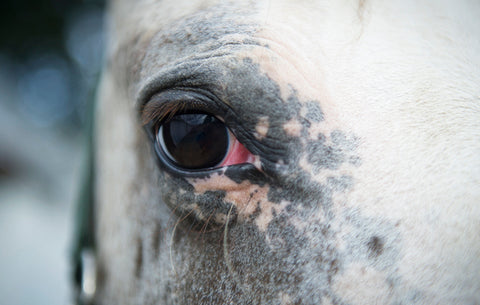
The symptoms of uveitis vary depending on the intensity of the inflammatory episode, its stage of development, and its location in the eye. However, in most cases, the main symptom of uveitis is pain in the horse, with one eye closed and very sensitive to light.
This disease, which can affect horses without showing any clinical signs or sometimes with just a simple fever, is an infection caused by bacteria. As the attacks continue, hence the name recurrent uveitis, a permanent change in the color of the iris, a more or less diffuse cataract, a deformed pupil, or a change in the size of the eyeball can be observed. It should be noted that with each new flare-up of uveitis, in addition to pain, the inflammation worsens the condition of the animal's eye and causes numerous sequelae. Lyme disease is also often the cause of recurrent equine uveitis.
Uveitis is a serious condition that should not be taken lightly. Apart from vision loss or impairment, it is often the management of pain that becomes complicated in the long term and can be a real nightmare for the owner. Some horses are genetically predisposed, particularly Appaloosas. Age is not a discriminating factor. In most cases, the horse will only receive symptomatic treatment in the form of eye drops to relieve pain, reduce inflammation, and attempt to limit the after-effects. The horse should remain in the dark or away from light as much as possible. Whether your horse is suffering from a single attack or a recurrence, our products are designed to help you manage this problem and protect your horse's eyes as best as possible. They allow horses to continue living normally, both at work and at rest, while being protected from the elements and light. Their field of vision is preserved. If in doubt, do not hesitate to consult your veterinarian. The sooner you intervene, the less difficult the attack will be to manage.
> See also: Medication and surgical treatments for uveitis in horsesAll measurements are approximate and are provided for informational purposes only.

| Mask size | Head circumference |
| XS - Shetland* | 84 cm |
| S - Poney* | 90 cm |
| M - Cob* | 94 cm |
| L - Full* | 100 cm |
| XL - XFull* | 110 cm |
For these masks, the main measurement is the width of your horse's forehead. To do this, you need to add together three measurements:
Add these 3 measurements (A+B+C) to obtain the size of your horse's forehead.
IMPORTANT: Do not measure directly from one eye to the other, as this will likely result in an inaccurate measurement.

| Mask size | Forehead size |
| XS - Shetland* | 7.5–8.7 inches |
| S - Poney* | 8.7–11.4 inches |
| M - Cob* | 11.5–13.5 inches |
| L - Full* | 13-14 inches |
| XL - XFull* | 15-17 inches |

| Size | A | B | C |
| XS (large Shetland) | 60 cm | 84 cm | 20 cm |
| S (pony) | 70 cm | 96 cm | 9.5 inches |
| M (cob) | 70 cm | 96 cm | 9.25 inches |
| L (full) | 75 cm | 105 cm | 27 cm |
If your horse is between sizes, we recommend choosing the smaller size.
| Mask size | Distance between the eyes |
| S - Poney* | 18 cm |
| M - Cob* | 21 cm |
| L - Full* | 9.5 inches |
| XL - XFull* | 26 cm |

* Précisions vocabulaire
XS = généralement poney petite tête
S = généralement poney / certains poulains de chevaux
COB : généralement petit cheval / tête compacte
FULL : généralement cheval standard
XFULL = généralement cheval grande tête ou petit cheval de trait
Vous vous êtes trompé ? Un échange est toujours possible et nous le faisons le plus rapidement possible à condition de nous en informer sous 14 jours.
> Voir les conditions de retour